

Vitamins for hair and skin: which ones really help?
Biotin, vitamin D, iron, zinc, vitamin C, glutathione. What the studies show, what to measure before taking anything, and when a vitamin infusion is justified.
 By Dr Alexandra Miles
•Reviewed October 2026
•10 min read
By Dr Alexandra Miles
•Reviewed October 2026
•10 min read
Which vitamins for hair and skin are actually worth taking? The question comes up constantly, and the answers sold in pharmacies, on social media or on supplement labels are often more confident than the research behind them. The medical literature says three simple things. Some micronutrients matter for the hair cycle and for the structure of the skin. A documented deficiency can affect both. And adding vitamins for someone who is not short of them has, on current data, no demonstrated effect. This article sorts out which vitamins have been studied, what you can reasonably expect from them, and what is worth measuring before you buy anything.
A reference review published in 2019 concludes that micronutrients play an important but not entirely clear role in hair loss, and that controlled trials are still needed. Biotin has shown benefit only in cases of deficiency or an underlying condition. Vitamin C supports collagen synthesis in the skin. For intravenous glutathione, evidence of an effect on the skin is lacking. Before any supplement, a blood test (ferritin, zinc, B12, folic acid, biotin) shows what is really low. That is what the YuBoost hair loss test does, at home and without a prescription.
Which vitamins for hair: what the research says
Hair is one of the fastest-renewing tissues in the body. The cells of the hair bulb divide constantly, which takes energy, amino acids and enough micronutrients. This is why a link between deficiencies and hair loss has long been suspected.
In 2019, a team led by dermatologist Antonella Tosti reviewed the literature (Almohanna et al., Dermatology and Therapy). They looked at the role of vitamins A, B, C, D and E, iron, selenium and zinc in non-scarring alopecia, where the follicle is still alive and can restart. Their conclusion is cautious. Micronutrients have an important but not entirely clear role in follicle development and immune function, and a deficiency may be a modifiable risk factor. The authors add that large double-blind, placebo-controlled trials are needed to find out whether supplementing improves regrowth, including in people who are deficient.
In practice, there is no single “best vitamin for hair” that suits everyone. There are deficiencies, which differ from person to person and have to be identified before you choose anything.
The markers worth knowing
These are the micronutrients most often linked to hair loss, and where to measure them at YuBoost. The blood draw is done at home by a qualified nurse.
| Micronutrient | Why it is looked at | Where YuBoost measures it |
|---|---|---|
| Iron (ferritin) | One of the minerals reviewed in the alopecia literature. Ferritin reflects your iron stores. | Hair loss test (ferritin) · Vitamin and mineral check-up (iron, ferritin, transferrin) |
| Zinc | A mineral studied in hair loss, involved in cell division. | Hair loss test · Vitamin and mineral check-up |
| Vitamin D | A vitamin studied in the follicle cycle and immune response. | Vitamin and mineral check-up |
| Vitamin B12 and folic acid (B9) | B vitamins involved in cell division. | Hair loss test (B12, folic acid) · Vitamin and mineral check-up |
| Biotin (B8) | The best-selling hair supplement. Useful mainly when a deficiency is proven. | Hair loss test |
The hair loss test (CHF 450) analyses 12 biomarkers: ferritin, zinc, vitamin B12, folic acid, biotin, estradiol, testosterone, cortisol, ANA, GGT, GOT and GPT. Results arrive within 7 working days, with personalised recommendations. If you mainly want an overview of vitamins and minerals, the vitamin and mineral check-up (CHF 370) covers vitamins B6, B9, B12 and D, iron, ferritin, zinc and magnesium, among others.
Vitamin D and hair, iron, zinc: where to start
“Vitamin D and hair” is one of the most frequent searches on the topic, and vitamin D is indeed among the micronutrients covered in the 2019 review. But “studied” does not mean “to be taken systematically”. The only reasonable move is to measure before supplementing. A level that is already normal gains nothing from being pushed higher, and a high dose taken for no reason is not harmless.
Iron deserves a mention of its own. Ferritin, which measures your reserves, is a standard part of the work-up for diffuse hair loss. We cover this in our iron injection page. Zinc follows the same logic: you measure it, correct it if it is low, and avoid taking high doses without follow-up. When a vitamin D or zinc deficiency is confirmed, a vitamin D injection or a zinc injection is available on medical indication.
Vitamin B8 (biotin) and hair: useful mainly when you are deficient
Vitamin B8, or biotin, is the vitamin most associated with hair. A 2017 review (Patel et al., Skin Appendage Disorders) found 18 published cases of improved hair or nails with biotin. In every one of them, the person had an underlying condition behind the problem. The authors write that research on biotin’s efficacy remains limited, that supplementation may help in acquired or inherited deficiency, and that evidence is not sufficient to recommend it to healthy people.
In concrete terms, if your biotin level is normal, adding 5,000 or 10,000 µg a day is unlikely to change your hair. Our biotin injection page explains how biotin is administered when a doctor considers it useful.
Biotin and blood tests: a point not to forget
Biotin can distort some laboratory results. The US FDA warns that it interferes with thyroid tests and other analyses, and that it can produce falsely low results for troponin, a marker used to detect heart attacks. If you take a biotin supplement, mention it before any blood test and ask your doctor whether you should stop for a few days beforehand.
Which vitamins for the skin: vitamin C first
For the skin, vitamin C is the best documented. A 2017 review (Pullar, Carr and Vissers, Nutrients) points out that normal skin contains high concentrations of it, that it stimulates collagen synthesis and that it contributes to antioxidant protection against UV damage. The authors also stress that the efficacy of a vitamin C cream, compared with an adequate dietary intake, is poorly understood, and that evidence is still missing for several supposed benefits.
This gives a useful rule: before adding a supplement or an infusion, check that your intake is sufficient. Citrus fruit, kiwi, peppers and cruciferous vegetables provide plenty. To understand what this vitamin really does, read our article on the benefits of vitamin C.
B vitamins play a role in cell renewal, and a marked biotin deficiency causes skin rashes. Outside of such deficiency situations, we did not find in the reviews cited here any evidence that extra intake improves the radiance or hydration of normal skin. Dull skin or persistent acne calls for a dermatology opinion and, depending on the case, a blood test, not a stack of supplements.
Glutathione and skin: where the research stands
Glutathione is an antioxidant made by the body. It is often presented as a skin-radiance product, even a skin-lightening one. A systematic review published in 2025 in the International Journal of Dermatology (Sarkar et al.) took stock of these uses. It found positive results for glutathione applied to the skin (a 0.5% concentration did better than 0.1% and placebo) and for oral glutathione (five randomised trials showing a drop in melanin index at doses of 250 to 500 mg a day), but with evidence of uneven quality and effects that are hard to sustain.
For the intravenous route, the picture is less favourable. The review found only one placebo-controlled study, in which the difference between the two groups did not reach statistical significance (p = 0.054). Its authors conclude that intravenous glutathione is contraindicated for skin lightening, because of a lack of demonstrated efficacy and because of side effects. They note it might act more as an antioxidant in melasma.
We prefer to say this plainly. There is currently no solid evidence that an infusion containing glutathione improves the skin. If the subject interests you, our glutathione injection page and our article on glutathione go through the uses, limits and risks. Looking for a glutathione injection in Switzerland? It is something to discuss with a doctor, on indication, not a beauty treatment.
Tablets, injection or vitamin infusion: what changes
Taken by mouth, vitamins go through digestion before reaching the blood. With a vitamin infusion or an injection, they are given directly into a vein or a muscle, under the responsibility of a healthcare professional. This is a difference in the route of administration, not proof of better efficacy. In the reviews cited in this article, we did not find a study comparing the intravenous route with the oral route for hair or skin health.
The intravenous route therefore has its place in specific situations: a confirmed deficiency, a problem with digestive absorption, someone who does not tolerate oral supplements. In that setting a doctor may judge an infusion useful. Outside it, an infusion replaces neither a balanced diet nor the search for the cause of hair loss. Our article on the effectiveness of intravenous vitamin infusions sums up what is known.
Two vitamin infusions offered for hair and skin
- Strong Hair (CHF 400): saline solution and electrolytes, B vitamins, vitamin B12, vitamin C 750 mg, glutathione 600 mg and biotin 5 mg. About 60 minutes, at home in Geneva, Lausanne and Zurich.
- Skin Glow (CHF 450): saline solution and electrolytes, B vitamins, vitamin B12, vitamin C 2 g and glutathione 1,200 mg. About 60 minutes, at home.
These infusions are offered on indication, after a blood test and a medical opinion. Given the data above, they are not presented as a treatment for hair loss or for skin radiance.
Where to start: measure, correct, reassess
A simple path avoids spending money for nothing.
- Measure. The hair loss test or the vitamin and mineral check-up shows what is actually low. A qualified nurse comes to draw blood at your home, in Lausanne, Geneva, Zurich and French-speaking Switzerland, without a prescription.
- Correct what is missing. Diet, a targeted oral supplement, or a vitamin infusion if a doctor considers it appropriate.
- Reassess. Hair grows slowly. Any effect is judged over several months, not a few weeks. Review with your doctor before adding other products.
Sudden hair loss, bald patches, or a painful or itchy scalp call for a prompt medical opinion, before any supplement. Watch combinations too: some vitamins and minerals should not be taken together, as our article on which vitamins can’t be taken together explains.
Conclusion: measure before choosing a vitamin for hair and skin
There is no miracle vitamin for hair and skin. The data show a real role for micronutrients, a use for biotin mainly in deficiency, an interest in vitamin C for collagen, and fragile evidence for intravenous glutathione on the skin. The most effective approach starts with a blood test. The hair loss test tells you what is missing, at home, with personalised recommendations. You then take only what you need.
Frequently asked questions
What is the best vitamin for hair?
There is no single one. The 2019 review on the subject covers vitamins A, B, C, D and E, iron, selenium and zinc, and concludes that their role is important but not entirely clear. What matters is the one you are short of. A test for ferritin, zinc, vitamin B12, folic acid and biotin shows which it is before you buy a supplement.
Does vitamin D affect hair?
Vitamin D is among the micronutrients studied in hair loss, but controlled trials are lacking to know whether correcting it makes hair regrow. The reasonable approach is to measure your level and correct any deficiency with a doctor, rather than supplement blindly.
Does vitamin B8 (biotin) make hair grow?
Mainly if you are deficient. A 2017 review found only 18 published cases of improvement with biotin, all in people with an underlying cause. The authors consider the evidence insufficient to recommend it to healthy people. Biotin can also distort some blood tests, so always mention it.
Is folic acid useful for hair?
Folic acid (vitamin B9) belongs to the B vitamins involved in cell division, and it is measured in the YuBoost hair loss test. We found no evidence that taking extra improves the hair of someone who is not deficient. The test shows whether a shortfall exists.
Which vitamin should I take for my skin?
Vitamin C is the best documented: it supports collagen synthesis and the skin’s antioxidant protection. An adequate diet generally covers needs. Dull, dry or acne-prone skin calls for a dermatology opinion before piling on supplements.
Does a glutathione injection in Switzerland improve the skin?
Evidence is lacking. A 2025 systematic review found only one placebo-controlled study on the intravenous route, with no significant difference, and concludes that intravenous glutathione is contraindicated for skin lightening. Any infusion containing glutathione is decided with a doctor, on indication.
Is a vitamin infusion more effective than tablets for hair?
No study cited here has shown it for hair or skin. An infusion changes the route of administration, not the need to prove a deficiency. It is justified on medical indication, for example with a confirmed deficiency or an absorption problem.
Sources
• Almohanna H.M., Ahmed A.A., Tsatalis J.P., Tosti A., The Role of Vitamins and Minerals in Hair Loss: A Review, Dermatology and Therapy, 2019: link
• Patel D.P., Swink S.M., Castelo-Soccio L., A Review of the Use of Biotin for Hair Loss, Skin Appendage Disorders, 2017: link
• Pullar J.M., Carr A.C., Vissers M.C.M., The Roles of Vitamin C in Skin Health, Nutrients, 2017: link
• Sarkar R., Yadav V., Yadav T. et al., Glutathione as a skin-lightening agent and in melasma: a systematic review, International Journal of Dermatology, 2025: link
• FDA, Biotin Interference with Troponin Lab Tests, Assays Subject to Biotin Interference: link
Measure before you supplement
At home in French-speaking Switzerland, no prescription needed.
Hair loss
Hair loss test
Ferritin, zinc, B12, biotin, folic acid, estradiol, testosterone, cortisol, ANA, liver enzymes. At home.
Deficiencies
Vitamin & mineral check-up
Vitamins B6, B9, B12 and D, iron, ferritin, transferrin, magnesium, calcium, zinc. At home.
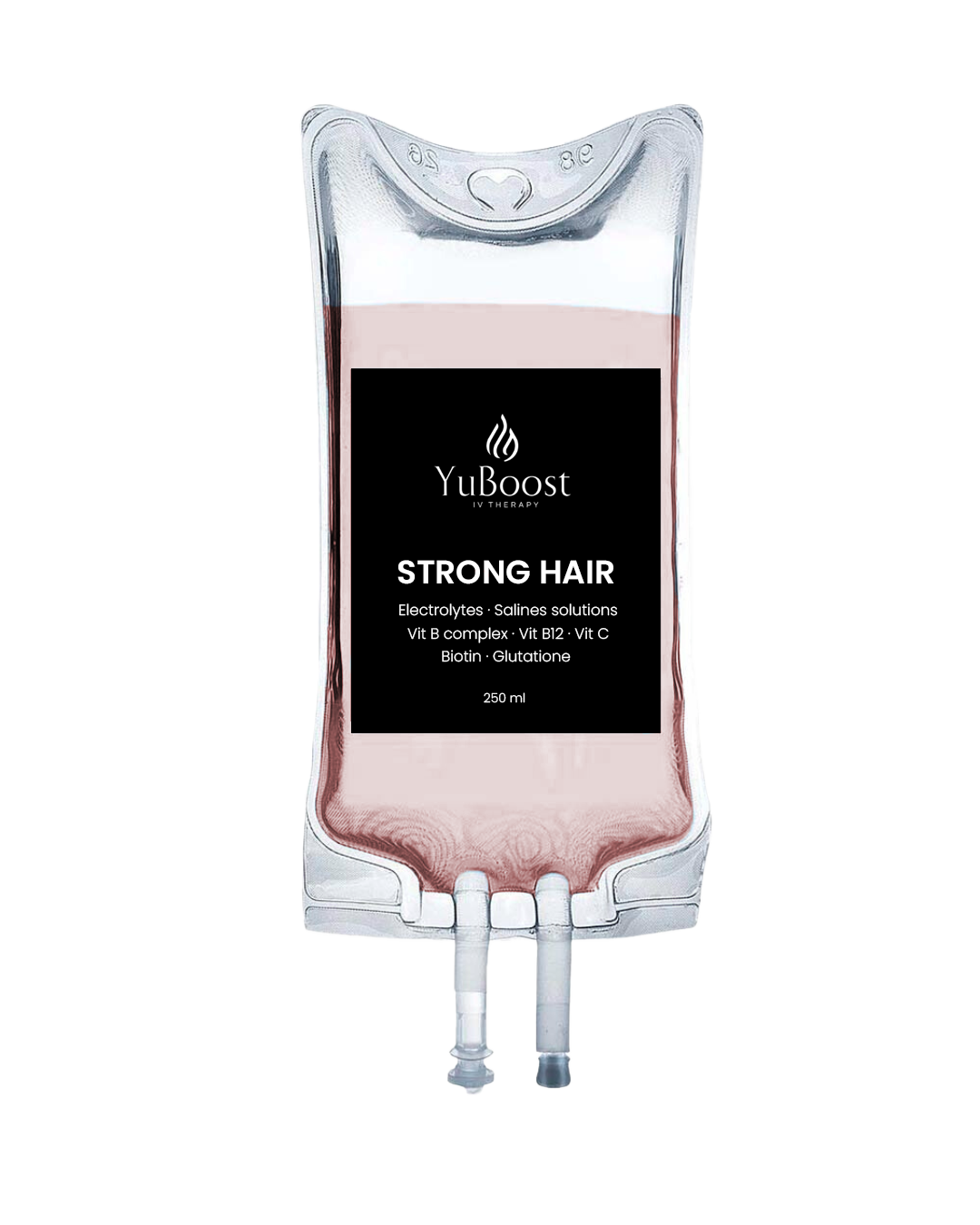
Vitamin infusion
Strong Hair
B vitamins, B12, vitamin C 750 mg, glutathione 600 mg, biotin 5 mg. After a blood test and medical opinion.
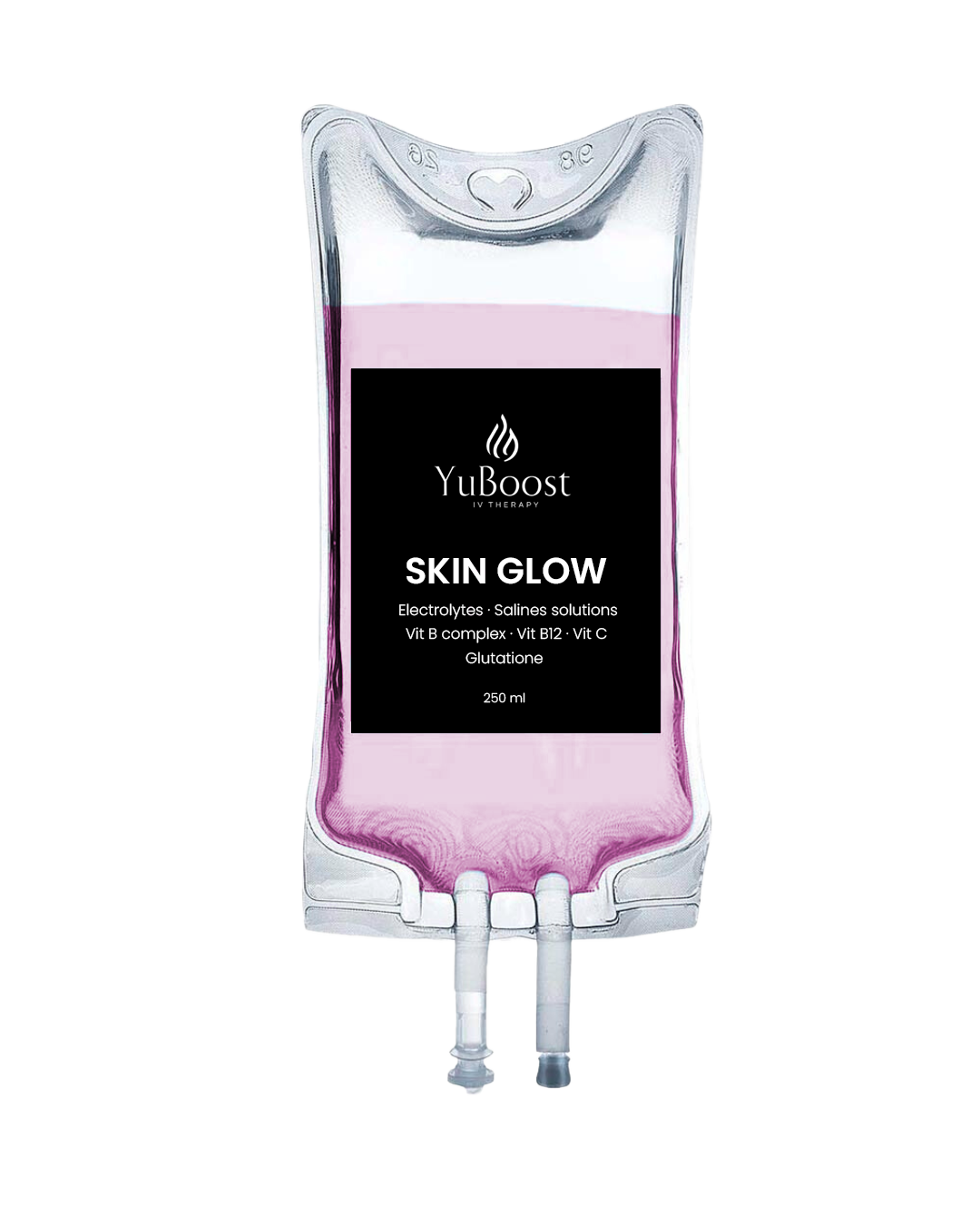
Vitamin infusion
Skin Glow
B vitamins, B12, vitamin C 2 g, glutathione 1,200 mg. After a blood test and medical opinion.
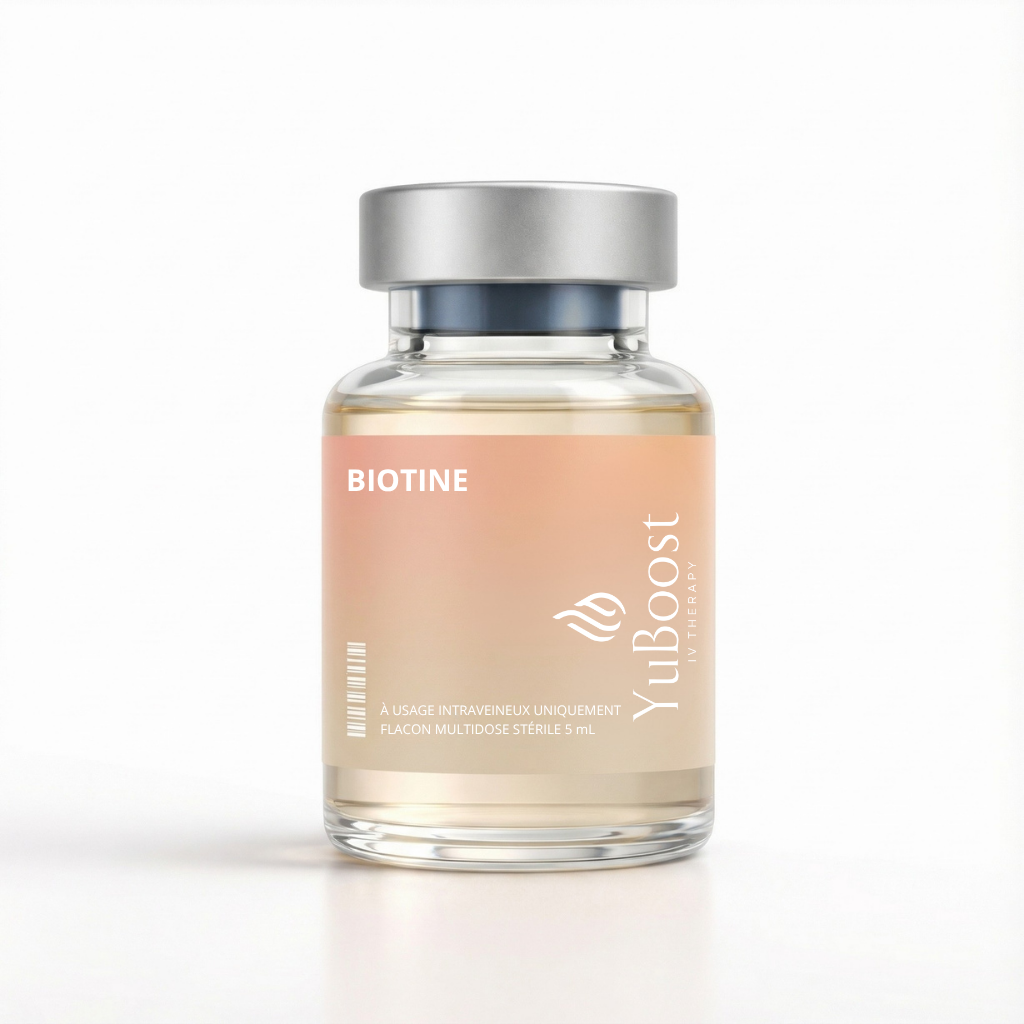
Vitamin B8
Biotin injection
The guide to injectable biotin: indications, deficiency, intake and routes of administration.
Measure before choosing your vitamin
Ferritin, zinc, vitamin B12, folic acid, biotin, hormones, cortisol, autoimmune and liver markers: 12 biomarkers drawn at home by a qualified nurse in Lausanne, Geneva, Zurich and French-speaking Switzerland, no prescription needed.
Book an appointment View the test: CHF 450This article is for information only and does not replace individual medical advice. In case of sudden hair loss, bald patches, widespread skin lesions or a painful scalp, see a healthcare professional. Always mention biotin intake before a blood test. Review: Dr Alexandra Miles, October 2026.
